The Lava Caves of Aokigahara Forest
One eruption, one flow, three caves that could hardly be less alike. What separates them is airflow, and it decides which one you should walk into.
The geologyHow a lava flow makes a cave
When Mount Fuji erupted in 864 the lava that reached this plain kept moving after its surface had chilled. The crust hardened into a roof while the molten rock beneath drained away downhill, and what it left behind was a tube: a hollow pipe running through solid basalt, sometimes for hundreds of metres.
Dozens of those tubes lie under Aokigahara Forest. Three have been opened, lit and railed for visitors, and they are startlingly different from one another despite coming from the same flow. The reason is airflow: a tube that traps cold air keeps ice all year, and one that breathes stays merely cold.
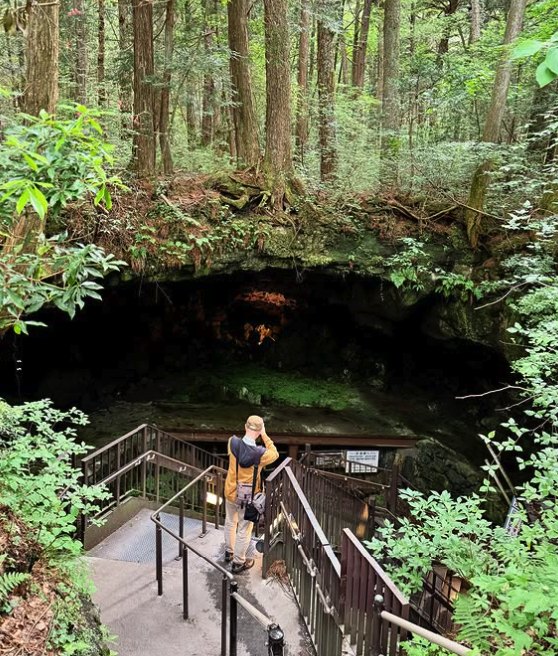
Narusawa Ice Cave
The coldest of the three, and the one that keeps ice through August. Temperatures stay below freezing all year, which is why ice was cut here and stored commercially from the early 1900s, long before refrigeration reached the villages.
The visit is short and steep. You go down a flight into a low chamber where ice pillars stand against the wall, the floor is genuinely slippery, and there are stretches where an adult has to stoop. Fifteen minutes covers it. Admission is 350 yen for an adult and 200 yen for a child, and it has no closing days, though winter hours shorten.
The wind caveFugaku Wind Cave
A near-constant zero degrees the year round, and the gentlest of the three underfoot. Its steady cold made it a natural cold store, and boxes of acorns and silkworm cocoons are still kept along the walls where visitors walk past them.
The passage is more level than the ice cave and the ceiling is kinder, which makes this the one to choose if you are unsure about the others. Fifteen minutes is enough, the fee is the same 350 yen, and a combined ticket with Narusawa Ice Cave is sold at whichever of the two you reach first.
The bat caveSaiko Bat Cave
The longest by a distance at close to 350 metres, with side tunnels and several chambers rather than a single passage. It is also the least comfortable: ceilings drop low enough that you will be bent double for stretches of it, and anyone with a bad back should think about the wind cave instead.
Which one, if you only have time for one
| Cave | Length | Temperature | Footing | Closed | Adult |
|---|---|---|---|---|---|
| Narusawa Ice Cave | Short | Below freezing all year | Steep steps, ice underfoot | Never | 350 yen |
| Fugaku Wind Cave | Short | Around 0°C all year | Level, kinder ceilings | Never | 350 yen |
| Saiko Bat Cave | Close to 350 m | Cool, not freezing | Long, low, stooping | 1 Dec – 19 Mar | 350 yen |
For ice and drama, take Narusawa. For comfort and the strangeness of a working cold store, take Fugaku. For distance underground and a genuine sense of the tube system, take Saiko and check the season first.
Go beyond the lit passages
The guided caving walks enter tubes that are neither lit nor railed, with the helmet, overall, gloves and headlamp handed out at the trailhead. From From $51 per person.
The caves a guide takes you into instead
The three show caves are the public face of the tube system. The guided walks go somewhere else: unlit tubes with no handrail and no walkway, entered on a ladder, under a permit the operator holds. That is what the equipment is for, and it is the clearest difference between paying 350 yen at a door and paying a fare.
Those walks also fold in the forest above, which is the part a cave ticket alone never gives you. Three hours buys the tube and the ground over it, with somebody explaining how one produced the other.
UndergroundWhat it is actually like down there
Cold arrives immediately and it does not ease. The air is still, the rock is wet, and sound behaves oddly because basalt swallows an echo instead of returning it. Where the lighting stops, the dark is total.
Bring a fleece whatever the month, wear shoes with grip, and expect to be looking down rather than around for most of the visit. Visiting the Forest has the fees and hours, Aokigahara Forest Tours compares every departure, and wildlife and plant life covers what grows over the roof of all this. An Aokigahara cave tour is the only way to reach the tubes that are not ticketed.