The short answer
Four marked routes matter here: the Sea of Trees Nature Trail through the middle of the forest, the cave-to-cave path linking Narusawa and Fugaku, the longer western leg out to Saiko Bat Cave, and the short climb to Koyodai Lookout. All are signed, none is difficult, and together they make a natural half day.
How the trails are laid out
Aokigahara Forest is flat. The lava plain it grew on has almost no relief, which means the walking is easy and the navigation is entirely a matter of following signs rather than reading contours.
The paths radiate from the main road that crosses the forest, and the three cave entrances sit along it with their own car parks. Everything below connects to that road at one end or the other, so there is no route here that strands you.
| Route | Time | Surface | What it is for |
|---|---|---|---|
| Sea of Trees Nature Trail | About 1 hour | Flat lava, uneven | The forest itself |
| Narusawa to Fugaku link | About 20 minutes | Flat, well signed | Two caves without moving the car |
| Western leg to Saiko Bat Cave | About 45 minutes | Longer, still flat | The third cave and the quiet |
| Koyodai Lookout climb | About 40 minutes return | Steps and a short ascent | The view that explains the name |
The main route through the middle
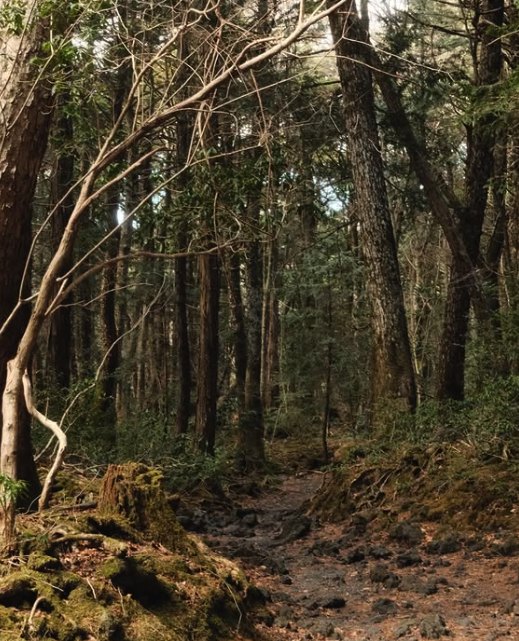
The Sea of Trees Nature Trail is the signed walking route through the heart of the forest, and the one most visitors come for. The canopy closes over you within a few minutes of the trailhead, the light goes green, and the noise of the road disappears faster than seems reasonable.
That last part has a cause. Porous lava absorbs sound rather than reflecting it, the moss layer absorbs more, and the closed canopy damps what is left. Stand still for a minute anywhere along it and the forest fills in around you.
An hour covers a comfortable loop. The surface is lava the whole way, so watch your feet on the root-crossed stretches.
The cave-to-cave path
Narusawa Ice Cave and Fugaku Wind Cave sit about twenty minutes apart on foot, and the marked path between them runs through the trees rather than beside the road. Doing it this way turns two fifteen-minute visits into a proper walk.
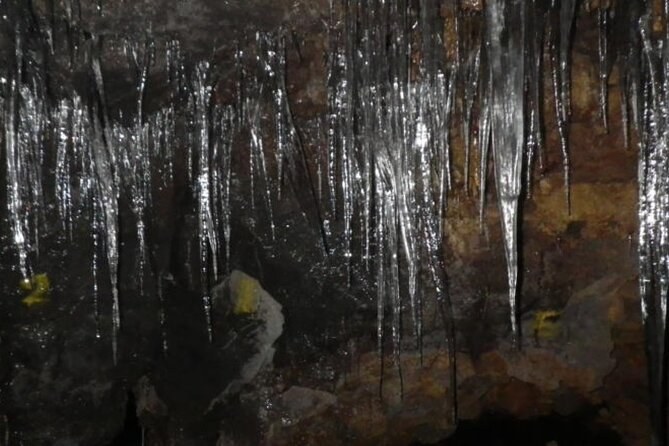
It is also the honest way to understand them. The lava caves came from the same flow in the same year and are startlingly different, and walking the ground between them is what makes that land.
The western leg to Saiko Bat Cave
The longer stretch out towards the third cave is the quietest walking here, because most day visitors drive it. Forty-five minutes each way through unbroken forest, with the trail well marked throughout.
Koyodai Lookout
A short climb up from the road to the one viewpoint that explains why this place is called the Sea of Trees. From the top the canopy runs unbroken to the foot of the mountain, moving in the wind the way water does.
Twenty minutes up, twenty back. Go early: the cloud that hides Mount Fuji tends to build through the morning, and the view is the difference between a good photograph and a grey one.
Putting the routes together
The natural half day is the nature trail, the cave-to-cave path and two caves, which comes to about three hours with the stops. Add the western leg and the third cave and it becomes a full but unhurried day.
Add Koyodai Lookout at the start rather than the end. The climb is easier on fresh legs and the air is clearer.
What the signs do and do not tell you
The main trailheads, the cave entrances and the route markers carry English alongside Japanese, and the navigation is genuinely straightforward. What the signage does not do is interpret.
Nothing tells you why the roots ride over the rock, what the fungi layer is doing, or which of the tubes under your feet are open. That gap is the entire argument for walking it with somebody, and it is a real one.
Reading the ground as you walk
The single most rewarding thing to do on any of these trails is to stop looking at the canopy and look down instead. The forest floor here is doing something no other Japanese woodland does, and once you can see it you cannot unsee it.
Pick any two neighbouring trees. One will usually be rooted flat across bare rock, its roots spread wide and visible like fingers over a table; the other will be upright in a pocket of accumulated grit and leaf litter. Nothing here can send a root downwards, because there is nothing to send it into.
That is also why fallen trunks matter so much. Nothing anchors deeply, so wind brings trees down more readily than in ordinary forest, and the rotting trunk then becomes the only reliable seedbed available. Look along any fallen tree and you will usually find a straight line of young trees growing out of it.
The trails in winter
Snow is possible from December to March and the trails stay walkable through it, though the marked routes become harder to read where drifting has covered the edges. The compensations are real: the canopy thins where the broadleaf species have dropped, the root structures become the most visible they ever are, and the ice inside Narusawa Ice Cave is at its best.
The constraint is light rather than cold. Sunset comes early enough in December that a day started after lunch will not fit a cave and a trail loop, and the bus frequency drops at the same time. Start before ten and keep the plan shorter than you would in June.
Where each trail begins
All four routes start from the main road that crosses the forest, and each has its own car park and its own signed entrance. The Narusawa Ice Cave and Fugaku Wind Cave entrances are the two busiest and the easiest to find; the Saiko Bat Cave entrance is further west and quieter.
Koyodai Lookout has its own small parking area and its own signed climb, separate from the cave entrances. Coming by bus, the stops sit along the same road, which is why the walking between the trailheads is so straightforward.
Walk it with somebody who reads the ground
Guided walks cover the same signed trails with the geology explained and the equipment included, from $51 per person.
For what lives along these paths see wildlife and plant life, and for the tubes underneath them, the lava caves.
Walks that spend real time on the trails
Three hours entirely inside the forest, an hour on the floor with a private car, and ninety minutes paired with a paddle and a village.
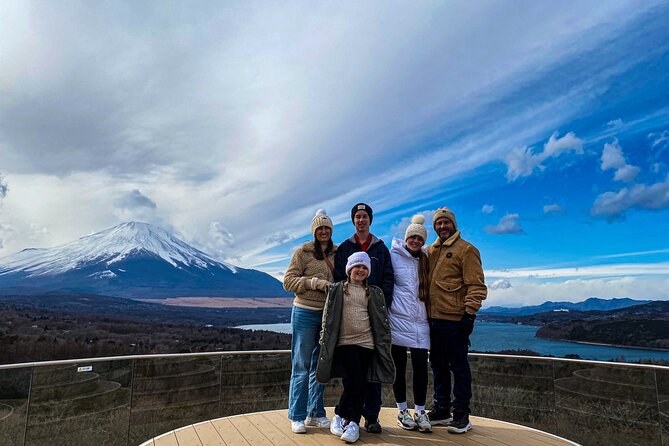
Hidden Fuji drive tour with a Local English speaking guide
From $386 per group (up to 4)
Check Availability
Private Guided Tour of the Mount Fuji Region (English/French)
From $386 per group (up to 8)
Check Availability