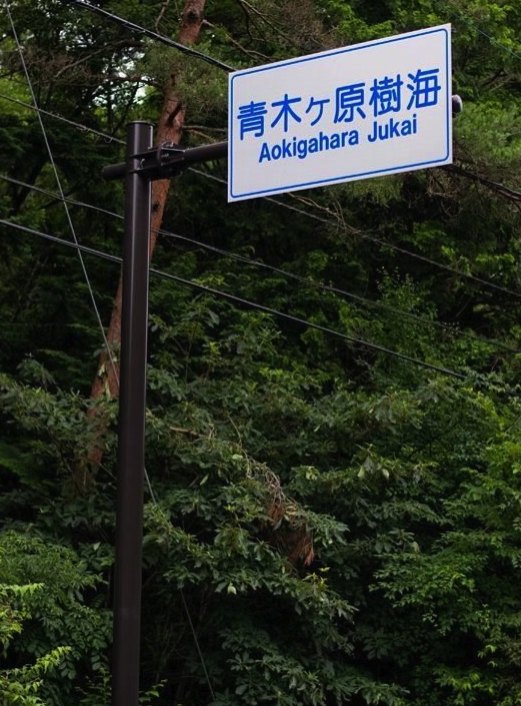
The short answer
Aokigahara Forest grew on lava from a single eruption in the year 864, it has almost no soil, its caves once refrigerated Tokyo, and the famous claim that compasses fail here is contradicted by the prefecture's own tourism authority.
1. It is younger than most of Japan's forests
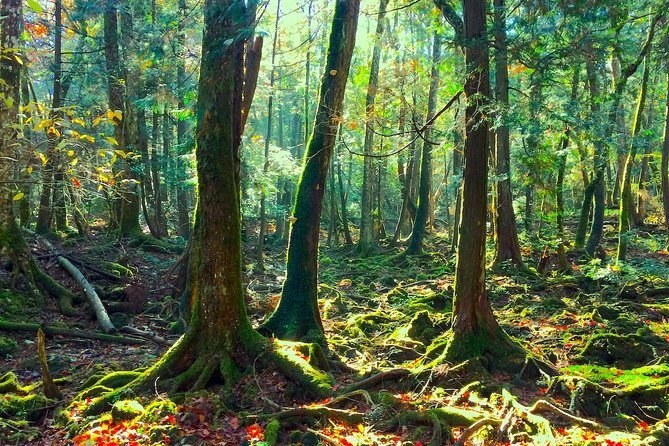
The rock underneath dates to 864, when Mount Fuji erupted on its north-western flank and poured lava across the plain. Everything growing here has arrived since, which by the standards of Japanese woodland is recent ground carrying old trees.
2. The eruption filled in a lake
The flow did not stop at empty ground. It ran into a large lake called Senoumi and filled most of it, leaving the smaller bodies of water that survive around the forest edge today.
3. There is almost no soil at all
Lava weathers slowly, and a millennium has produced only a thin organic layer. That is why the roots here spread sideways over bare basalt hunting for cracks instead of descending, and why so much of the forest floor is a tangle you step over.
4. The forest is about 30 square kilometres
Large enough to lose the road inside a few minutes of walking, small enough that every marked trail reaches a road at both ends. The name Jukai — sea of trees — describes how the canopy looks from above.
5. It swallows sound
Visitors notice the quiet before anything else. Porous lava absorbs sound instead of returning it, and the moss and the closed canopy absorb the rest, so there is almost no echo here and no carrying distance.
6. One of its caves refrigerated Tokyo
Narusawa Ice Cave stays below freezing all year, and from the early 1900s ice was cut there and shipped out for cold storage long before refrigeration reached the villages. The ice pillars you walk past are the working stock of a former industry.
7. Another one stored silkworm eggs
Fugaku Wind Cave holds a near-constant zero degrees, which made it a natural cold store rather than an icehouse. Boxes of acorns and silkworm cocoons are still kept along its walls where visitors walk past them.
8. The three caves came from one flow and could not be less alike
| Cave | Temperature | Length | What it was used for |
|---|---|---|---|
| Narusawa Ice Cave | Below freezing all year | Short | Cutting and storing ice |
| Fugaku Wind Cave | Around 0°C all year | Short | Cold storage for seed and cocoons |
| Saiko Bat Cave | Cool, not freezing | Close to 350 m | Nothing — it holds a bat colony |
The difference is airflow. A tube that traps cold air keeps ice; one that breathes stays merely cold.
9. Compasses work perfectly well
This is the one worth correcting. Official Yamanashi tourism states plainly that it is a common misconception that compasses are useless here, and that a compass held at normal height behaves exactly as expected.
The story has a real root: the lava is rich in magnetite, and an instrument laid flat on the rock itself can be pulled off true. Somebody observed that once and generalised it into a legend.
10. A bat colony closes a cave for a third of the year
Saiko Bat Cave shuts from 1 December to 19 March so its hibernating bats are left alone. Waking a hibernating bat burns fat reserves it cannot replace until spring, which is why the dates are enforced rather than advisory.
11. It sits inside a national park
The forest lies within Fuji-Hakone-Izu National Park and the wider Mount Fuji World Heritage landscape. Nothing may be removed, and the marked-path rule is part of how the thin living layer underfoot is kept intact.
12. Trees fall more often here than in ordinary woodland
Nothing anchors deeply, so wind brings trees down more readily. The fallen trunks then become nurseries for the next generation, which is why you keep seeing young trees growing in a straight line along a rotting log.
13. The mountain is often invisible from inside it
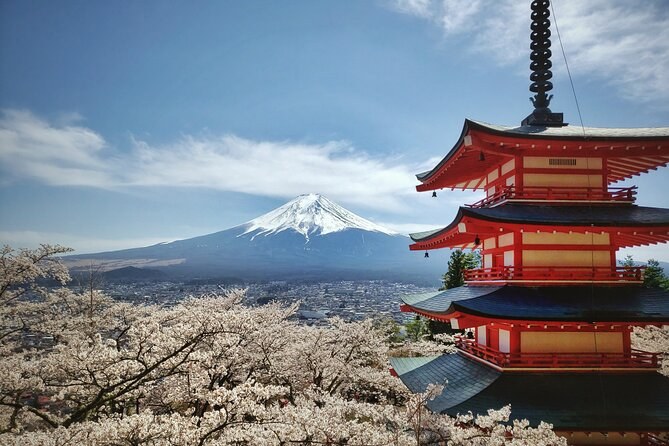
Mount Fuji stands directly above the forest and you will barely see it from the trail, because the canopy is closed. Koyodai Lookout exists for exactly this reason, and it is a twenty-minute climb.
14. Nothing about visiting it requires a permit
The trails are free and open at any hour, and the caves sell tickets at the door for 350 yen. The only permits in play are the ones a guide holds for the lava tubes that are neither lit nor railed.
Why so much written about this place is wrong
Aokigahara Forest has a reputation that arrived long before most of the people writing about it did, and a great deal of what circulates is repeated rather than checked. The compass claim is the clearest example: it is contradicted by the prefecture's own tourism authority, and it still appears in nearly every popular account.
The same applies to the idea that the forest is trackless, or that entering it requires nerve. It is a national park with signed trails, three ticketed visitor attractions, car parks and a bus route. Roughly a thousand years of geology are the genuinely remarkable thing here, and they get a fraction of the attention.
The practical upshot is worth saying plainly. Read the official Yamanashi tourism material before you read anything else about this forest, keep to the marked paths, and treat everything else you have heard as a story until something reliable confirms it.
What the eruption of 864 actually did
The Jogan eruption is the second of Mount Fuji's two great recorded eruptions and, by most accounts, the more destructive. It broke out on the mountain's north-western flank rather than at the summit, and the lava it produced ran downhill across the plain below over a period of months.
It reshaped the map. The flow filled most of the lake it ran into, isolating the smaller bodies of water that survive today, and the imperial court responded by ordering a shrine built in the province to appease the mountain's deity. The forest is the visible remainder of all of that, still sitting on top of it.
See it rather than read about it
Guided walks reach the tubes behind half of these facts, with the equipment handed out at the trailhead. From $51 per person.
The practical side is on Visiting the Forest, and How to Get There covers the buses out from Kawaguchiko.
Departures that reach what this post describes
The unlit tube behind the ice story, the full day that stops at Fugaku Wind Cave, and the long Tokyo run that takes in all three caves.
Mt Fuji Hidden Gem & Gotemba Premium Outlets with Local Driver
From $628 per person
Check Availability