What actually differs between these cave tours?
Not the geology. Every lava tube under Aokigahara Forest came out of the same eruption in the same year, and the rock in one is the rock in the next. What separates the departures is whether the tube you enter is a lit public attraction or an unlit one, how long you spend in the forest above it, whether the admission is inside the fare, and where the day starts.
Sort on those four and the choice takes a minute. Sort on price alone and you will end up underground for fifteen minutes when you wanted three hours, or the reverse.
Show cave or guided lava tube — what is the difference?
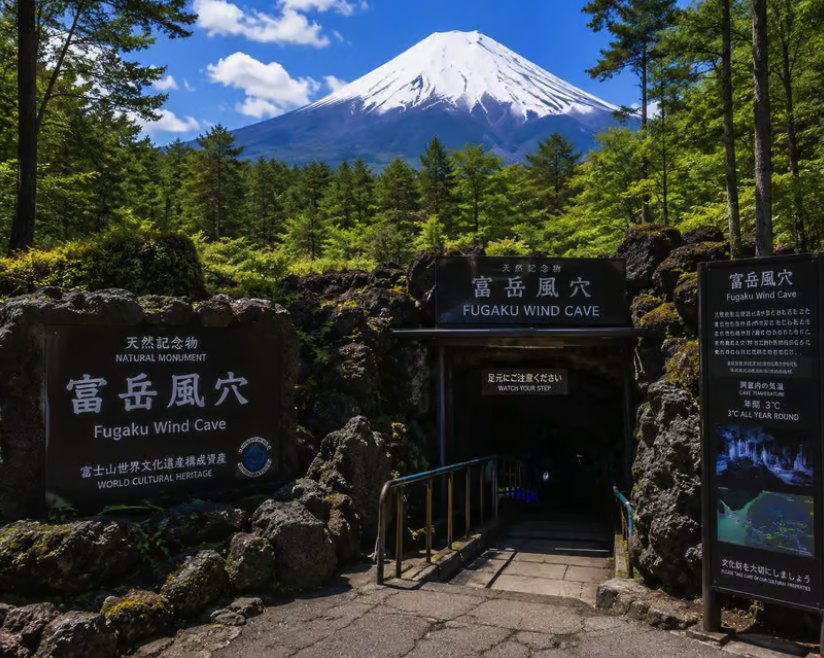
A show cave is a business. Narusawa Ice Cave, Fugaku Wind Cave and Saiko Bat Cave each have an entrance, a kiosk, lighting where the path runs, handrails and a fixed 350 yen fee. You walk in, you walk round, you walk out, and fifteen minutes covers it.
A guided lava tube is none of those things. No lighting, no rails, no walkway, entered on a ladder, under a permit the operator holds rather than one you can buy. That permit is the entire reason a fare exists: there is no version of this you can arrange for yourself at a kiosk.
Both are worth doing and they are not substitutes. The show caves are the cheapest genuinely interesting hour available anywhere near Mount Fuji; the guided tube is the one that feels like caving.
Which walk goes furthest underground?
The three-hour spelunking walk from Kawaguchiko, without much competition. It is the only departure here that enters a tube outside the ticketed three, and roughly a third of its running time is spent below the surface.
Among the show caves themselves, Saiko Bat Cave is by far the longest at close to 350 metres with side tunnels and several chambers. No guided departure here makes it a headline stop, so if distance underground is the point you will be walking into that one on your own ticket.
Which tour includes the helmet and the headlamp?
Both of the short walks from the Kawaguchiko area. The spelunking morning hands out a helmet, an overall, gloves and a headlamp, because you are going into unlit ground on a ladder. The Sea of Trees walk hands out a helmet and gloves for a railed descent with lighting along the path.
None of the long day trips from Tokyo includes caving equipment, because none of them enters a tube that needs it. They visit the show caves, where the only equipment required is a coat.
Which cave tour includes the admission?
Three of the departures cover it and the rest do not, and it is worth knowing which before you compare headline prices.
| Departure | Hours underground | Gear included | Admission | Departs from | Price |
|---|---|---|---|---|---|
| Ice cave spelunking walk | About 1 hour, unlit tube | Helmet, overall, gloves, lamp | Permit inside the fare | Kawaguchiko Station | From $51 pp |
| Sea of Trees and ice cave walk | Part of 3 hours, railed | Helmet and gloves | Included | Michi-no-eki Narusawa | From $55 pp |
| Full day with a Spanish guide | 30 minutes, Fugaku Wind Cave | None needed | Included | Mishima Station | From $93 pp |
| Gotemba and Mount Fuji private day | 15 minutes each, two caves | None needed | Paid at each door | Tokyo, hotel pick-up | From $628 pp |
| Chartered car to Fuji and Hakone | 15 minutes each, if chosen | None needed | Paid at each door | Tokyo, any address | From $628 pp |
The pattern is simple enough to remember: the short walks from the lake include everything, and the long private days from Tokyo include the driving and leave the yen at the cave door.
Can you enter a lava tube without a guide?
You can enter three of them, and only three. Narusawa Ice Cave, Fugaku Wind Cave and Saiko Bat Cave are open to anybody who turns up with 350 yen, and no permit, booking or equipment is required for any of them.
Everything else underneath this forest is closed to individual visitors. The tubes the guided walks enter are accessed under operator permits, so booking a walk is the route in rather than turning up at an entrance.
Is any of this too tight for claustrophobia?
Honestly, yes, in places. Narusawa Ice Cave has a low chamber where an adult stoops and the only light is what the installation provides. Saiko Bat Cave has stretches where you are bent double for several minutes at a time. The guided spelunking walk puts you in an unlit tube with a headlamp as your only light source.
Fugaku Wind Cave is the gentle one: level, short, and open enough that most people who are uneasy about caves manage it comfortably. If you want the forest without the enclosure, the Sea of Trees walk spends most of its three hours above ground and the cave section is railed and lit throughout.
Which cave tour suits a first visit?
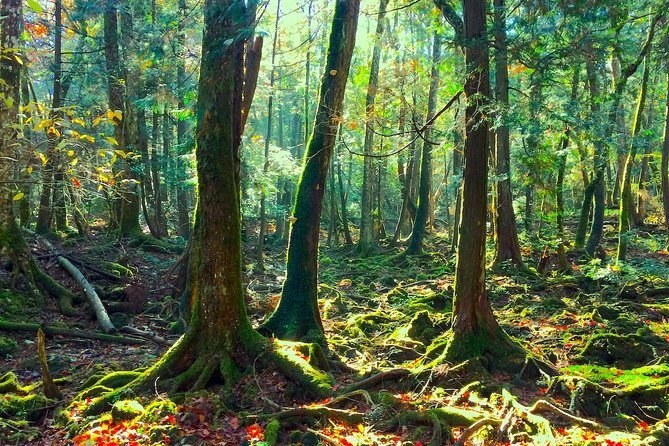
The Sea of Trees walk, for most people. Three hours entirely inside Aokigahara Forest, cave admission included, a shuttle from around Kawaguchiko Station, and a descent that is managed rather than adventurous. You come away understanding the place rather than having glimpsed it.
If your appetite runs the other way — if a ladder into the dark is the appeal rather than the obstacle — the spelunking morning is the cheaper of the two and carries more traveller ratings than any other short walk here.
Which tour works with children?
The Sea of Trees walk takes children from six with an adult, and under-twelves need a parent or guardian alongside. Its trail is flat and its cave section is railed, which is the right combination for a family.
The spelunking walk asks for a ladder descent and low headroom, which suits older children who want an adventure and does not suit small ones. The long private cars all carry children and two of them have infant seats, but their forest time is measured in half hours rather than hours.
What does each tour cost per hour underground?
An unfashionable way to compare, and a revealing one. The spelunking walk puts roughly an hour in a tube for fifty-one dollars. The Spanish full day puts thirty minutes in Fugaku Wind Cave for ninety-three, and the rest of the fare buys ten other stops around the mountain.
Neither figure makes one better than the other. It does mean that if caves are the reason you are coming, the two short walks from the lake are dramatically better value than any full-day circuit, and if they are one interest among several then the reverse is true.
Which leave from Kawaguchiko, and which from Tokyo?
Both short walks assume you are already at the lake. The spelunking morning collects at Kawaguchiko Station or a lakeside hotel; the Sea of Trees walk meets at Michi-no-eki Narusawa with a shuttle from around the station.
Everything reaching a cave from Tokyo is a nine to eleven hour day, and about four of those hours are road. That is not an argument against them — a single day out of the city has to include the driving somewhere — but it does mean the cave itself will be a fifteen-minute stop rather than the point of the day.
Who should not book a cave tour at all?
Anyone whose back will not tolerate stooping, anyone for whom enclosed spaces are genuinely difficult, and anyone hoping to see Aokigahara Forest in comfortable shoes on level ground. All three caves involve steps, wet floors and low ceilings, and no amount of choosing between them removes that.
The good news is that the forest above them asks none of it. The Sea of Trees Nature Trail is flat, wide, free and open at any hour, and an hour on it is a complete visit to this place by any reasonable measure.
What do you actually need to wear?
Closed shoes with a real tread, and a warm layer. That is the whole list, and both items matter more than they sound. Cave floors are wet, uneven and in one case iced, and a worn trainer sole on wet lava is the commonest way a visit here goes wrong.
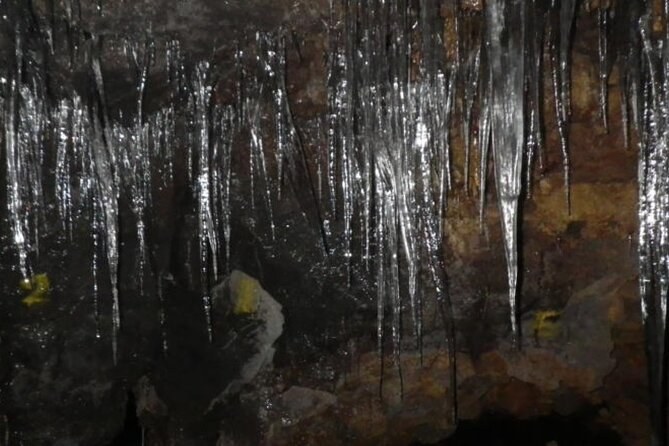
The layer is the one people skip. Narusawa Ice Cave is below freezing in every month of the year and Fugaku Wind Cave holds around zero, so a fleece belongs in your bag in August as much as in January. Travellers who wrote about the caves almost all mention wishing they had worn more.
The guided walks add long sleeves and long trousers to that, and hand out the helmet, gloves and lamp themselves. Nothing else needs buying.
How far ahead should you book?
The show caves need no booking at all. Turn up on the day with 350 yen and walk in; there is no queue worth planning around outside the autumn colour weeks.
Guided walks are a different matter. Most confirm immediately, which makes the day before workable, but one of the two short walks takes up to 48 hours to confirm and should be booked two or three days out. The private cars from Tokyo fill earliest in autumn and over the New Year period.
Because every departure refunds in full up to 24 hours ahead, booking early costs nothing and holds the date you actually want. There is no advantage in waiting for a forecast you cannot see yet.
Which one would we book?
For a first visit with the forest as the reason for coming: the Sea of Trees and ice cave walk. Three hours entirely inside Aokigahara Forest with the admission already paid is the single most coherent product here, and nothing else is shaped like it.
For anyone who wants the caving rather than the walking: the spelunking morning, at fifty-one dollars with all the equipment handed out. For a single day from Tokyo with the forest as one part of it: the private day with the cooked lunch, which reaches the trail as well as the lakes.
Frequently asked questions
Do I need to book a cave tour in advance?
How cold is it underground?
Can I visit all three show caves in one day?
Is the ice really there in summer?
What if I book and the weather turns?
One walk of each shape
One of each shape discussed above: the unlit tube on a ladder, the railed walk with admission paid, and the full day that takes in a show cave among eleven stops.