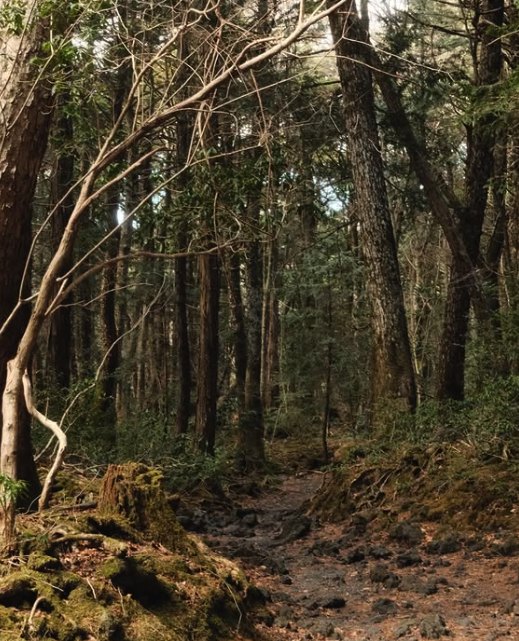
Can you walk into Aokigahara Forest on your own?
Yes, freely, and this is the part most visitors are surprised by. The marked trails carry no fee, no permit, no booking and no closing time. You can walk in at six in the morning in February if you want to.
The forest is a national park with signed routes, three ticketed visitor attractions, car parks and a bus service along the road that crosses it. Treated sensibly it is an ordinary and very rewarding forest walk, and a large proportion of the people there on any given day arrived by themselves.
Is there an entry fee or a permit?
None for the forest. The three lava caves each sell a ticket at their own door at 350 yen for an adult and 200 yen for a child, and a combined ticket covering two of them is available at whichever you reach first.
The only permits in play anywhere here belong to tour operators, and they cover the unlit lava tubes that are not open to individual visitors. There is no paperwork of any kind for a member of the public walking the trails.
Which trail should you take if you go alone?
The Sea of Trees Nature Trail, and then the marked path between Narusawa Ice Cave and Fugaku Wind Cave. Between them those two routes give you the forest floor, the canopy, the quiet and two very different caves, in about two and a half hours of easy walking.
Add Koyodai Lookout at the start if the sky is clear. Forty minutes return, and it is the one place that shows you what the name means.
Can you reach the trailheads by public transport?
Yes. The Green Line Retro Bus runs from Kawaguchiko Station west along the lake and out towards the cave trailheads, reaching the Saiko Bat Cave stop in around half an hour. The Blue Line stops at Michi-no-eki Narusawa in about twenty-five minutes for 680 yen one way.
Services are frequent enough in the middle of the day and thin at both ends of it, which is the whole practical difficulty with doing this independently.
What time does the last bus leave?
Earlier than almost everybody expects, and this single fact shortens more days here than anything else. The cave stops are on a rural road with no taxi rank and no shelter to speak of.
Can you do the three caves without a guide?
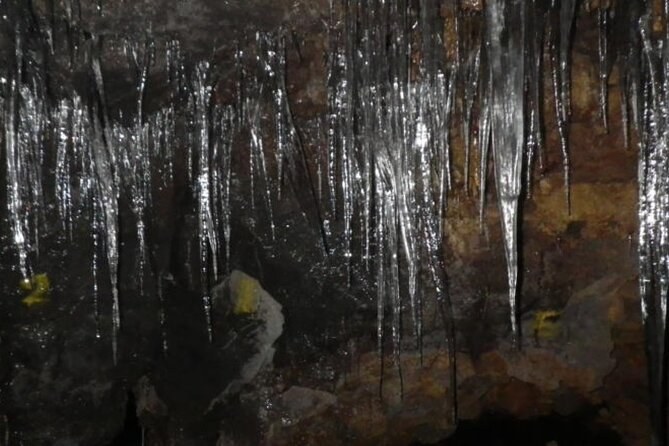
All three, easily, and this is the strongest argument for going alone. Narusawa Ice Cave, Fugaku Wind Cave and Saiko Bat Cave are lit, railed and staffed, they take fifteen to twenty minutes each, and the marked paths between them run through the forest rather than beside the road.
Three cave tickets and a return bus fare buys a half day that most guided departures do not improve on. What it does not buy is a tube that has no lighting in it.
What do you miss going alone?
Three things, in order of how much they matter.
The unlit tubes. Not available at any price to an individual visitor. If caving rather than cave-visiting is what you want, a fare is the only route.
The interpretation. The signage navigates but does not explain. Nothing at the trailhead tells you why one hemlock lies flat across the rock while its neighbour stands upright, what the fungi layer is doing, or why the forest swallows sound.
The return leg. Every guided departure puts you back where it collected you.
Is walking Aokigahara Forest alone safe?
On the marked trails, yes. The ground is flat, the routes are signed in English as well as Japanese, and every path reaches a road at both ends. The reputation should not be doing any work in this decision.
The real hazards are mundane. Wet lava is genuinely slippery and stays that way for hours after rain; the exposed roots are a trip hazard for anyone watching the canopy; and winter darkness arrives early. All three are handled by decent shoes and an early start.
| Concern | Reality | What handles it |
|---|---|---|
| Getting lost | The marked routes are signed and reach roads at both ends | Stay on the path; download the map before you go |
| Compasses failing | Officially contradicted — they work at normal height | Nothing; the claim is not true |
| Wet lava | The one genuinely slippery surface here | Closed shoes with a real tread |
| Phone signal | Patchy under the canopy, absent underground | Download the trail map at the station |
| Winter darkness | Light goes early from November | Start before ten and shorten the plan |
| Bears | Present in the wider region, rare on the trails | Walk in company and make some noise |
What should you carry?
Closed shoes with grip, a fleece whatever the forecast says, water, coins for the cave kiosks and a downloaded map. That is the whole list, and the fleece is the item people leave behind and regret.
Fugaku Wind Cave sits at around zero degrees in August and Narusawa Ice Cave stays below freezing in every month of the year. Neither has anywhere warm inside to retreat to.
Are the trail signs in English?
The main trailheads, the cave entrances and the route markers are, which is why navigating independently is genuinely straightforward. The deeper interpretation boards are more often Japanese only.
That gap is not a safety problem. It is the reason a first visit with somebody explaining the ground is more rewarding than a first visit without, which is a different argument entirely.
When is going alone the wrong call?
When you have no car and a tight return connection, because the bus timetable will decide your day rather than you. When the point of the trip is caving rather than walking, because the interesting tubes are not open to you. And when you want to understand what you are looking at rather than simply see it.
Everything else — budget, independence, pace, photography, a slow morning with nobody talking — argues for going alone, and those are good reasons.
How does a self-guided day fit together?
The version that consistently works starts early and moves west. Take the first practical bus from Kawaguchiko, get off at the Fugaku Wind Cave stop, and walk from there rather than riding between entrances.
Fugaku first, because it is the gentlest and it sets up what a lava tube is. Then the marked path through the trees to Narusawa Ice Cave, about twenty minutes and the best walking of the morning. Then the nature trail loop, unhurried, because that is the part worth finishing on rather than squeezing in.
That comes to roughly four hours including the walking, costs two cave admissions and a return bus fare, and leaves Saiko Bat Cave and Koyodai Lookout for a longer day or a second visit.
What about winter, alone?
Entirely doable and quieter than any other season, with two constraints that compound. Saiko Bat Cave is shut from 1 December to 19 March, and daylight runs out early enough that a day started after lunch will not fit a cave and a trail loop.
Bus frequency drops at the same time of year, which is the part that catches independent visitors. The pairing of an early sunset and a thin timetable is what turns a relaxed afternoon into a cold wait at a rural stop.
Start before ten, take the two open caves rather than three, and treat the last service as the fixed point the day is built around. Do that and winter is the best time of year to have this forest to yourself.
Where do you park, and what does that change?
Each of the three lava caves has its own car park at its own entrance, and Michi-no-eki Narusawa has a larger one with a shop, a restaurant and proper facilities. Koyodai Lookout has a small area of its own.
A car changes the arithmetic here more than anything else. The three entrances are minutes apart by road, the timetable stops mattering, and a winter visit stops being a race against the light. It is the single strongest argument for doing this independently.
The trade is that driving between the entrances skips the walking between them, which is the best part. Park once and walk the marked paths, rather than treating the caves as three separate car parks.
What does going alone actually save you?
A guided walk from the lake starts at $51 per person. Doing the equivalent independently costs a return bus fare and two or three cave admissions, which comes to a few thousand yen for two people.
The saving is real but not enormous, and it narrows sharply if you end up in a taxi because the last bus has gone. With a car, the arithmetic tips decisively the other way: parking is easy, the three cave entrances are minutes apart by road, and the whole timetable problem disappears.
Frequently asked questions
Do I need to book anything to walk in Aokigahara Forest?
Is it safe to walk there alone?
Do compasses work in the forest?
Can I drive and park at the caves?
How long does the main trail take?
What only a guide reaches
If the verdict above pushed you towards a guide, these two reach ground a trail ticket does not: the railed forest walk, and a private car for the whole group.
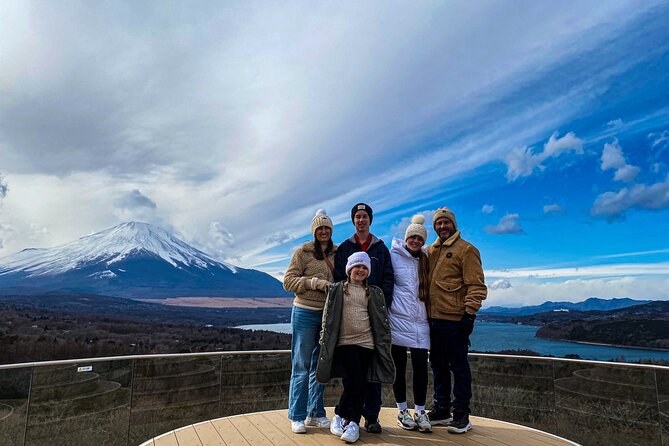
Hidden Fuji drive tour with a Local English speaking guide
From $386 per group (up to 4)
Check Availability